When the Calendar Remembered Every Saint: Reviving the Forgotten Feast Days of the Chilterns
Photo: Gitanes232, CC BY-SA 4.0, via Wikimedia Commons
In the village of Chinnor, as in countless English communities, the year is measured by familiar landmarks: Christmas, Easter, the school summer holidays, and the occasional Bank Holiday weekend. But for many centuries, the English rural calendar was far more densely populated with sacred occasions — days set apart not by government decree but by the accumulated devotion of generations who found in the saints a living connection between heaven and the particular soil they worked.
These feast days and saints' days did not merely mark religious obligation. They organised agricultural labour, governed market days, determined when contracts began and ended, and provided communities with regular occasions for gathering, feasting, and collective prayer. Their disappearance from the common consciousness was gradual and largely unremarked — a quiet fading rather than a dramatic rupture. But across the Chilterns, a small and thoughtful movement is now working to recover what was lost.
A Calendar Once Crowded with Saints
The pre-Reformation English liturgical year contained well over a hundred feast days of varying significance, from the great solemnities of Christmas and Pentecost to the more localised observances of regional patron saints and the dedications of individual parish churches. Many of these days carried practical as well as devotional weight. Candlemas, on the second of February, marked the formal end of the Christmas season and the traditional date for reviewing agricultural tenancies. Rogationtide, in the weeks before Ascension, saw processions through the fields as communities asked God's blessing on the coming harvest and — practically — walked the parish boundaries to maintain communal memory of land ownership.
Lammas, on the first of August, celebrated the first fruits of the wheat harvest and took its name from the Old English hlaf-maesse, or loaf mass — a eucharistic offering of the first-baked bread. Michaelmas, on the twenty-ninth of September, marked the end of the harvest season, the settling of accounts, and the beginning of the autumn quarter. These were not obscure theological abstractions. They were woven into the texture of everyday life in ways that gave the sacred calendar an immediate and tangible relevance.
The Reformation, the subsequent disruptions of the Civil War period, and the gradual secularisation of public life over the following centuries stripped most of these observances from the common calendar. The Church of England retained a core of major festivals, but the richer ecosystem of minor feasts — particularly those associated with local saints and regional traditions — largely fell away.
The Quiet Revival
In several Chilterns parishes, clergy and lay leaders have begun the careful work of reintroducing some of these observances, not as antiquarian curiosities but as living practices capable of nurturing congregational identity and deepening spiritual life.
Rogationtide has proved one of the most accessible points of re-entry. The tradition of blessing the fields and walking the parish boundaries connects readily with contemporary concerns about the natural environment, the stewardship of land, and the relationship between faith and place. Several local churches have revived Rogation Sunday walks in recent years, gathering after the morning service to process through farmland and footpaths, offering prayers of blessing and thanksgiving at significant points along the route.
"People respond to it immediately," observes one local vicar who introduced a Rogation walk to her parish three years ago. "There's something about walking the land together, praying as you go, that feels both ancient and entirely natural. It doesn't feel like a re-enactment. It feels like something we should have been doing all along."
Lammas has attracted interest from congregations with connections to local food initiatives and harvest ministries. The image of bringing the first loaf of the new wheat to the altar resonates with communities already engaged in conversations about food justice, the provenance of what we eat, and the eucharistic significance of bread. Some churches have begun marking the first Sunday of August with a Lammas liturgy that incorporates locally baked bread and reflections on the agricultural heritage of the Chilterns.
The Saints Themselves
Beyond the seasonal observances, a number of clergy across the area have begun drawing their congregations' attention to the saints whose feast days might carry particular local resonance. Saint Birinus, the apostle to the West Saxons who was active in the upper Thames valley in the seventh century, is one figure whose feast day — the fourth of December — is receiving renewed attention. His missionary journeys through the region that would eventually become Oxfordshire give him a geographical proximity that makes his story feel less remote than those of saints associated with more distant places.
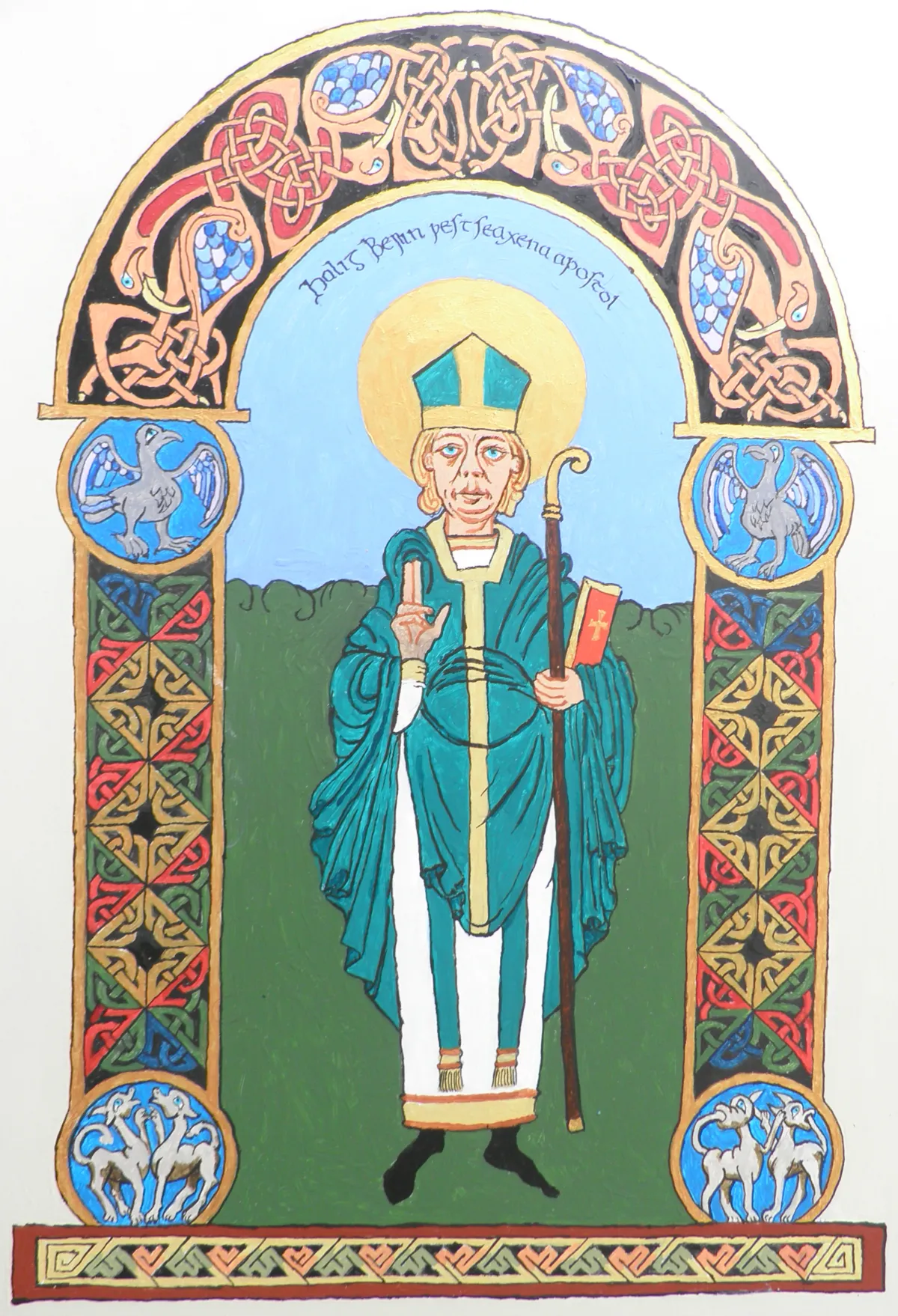 Photo: Saint Birinus, via saintbirinus.uk
Saint Frideswide, patron of Oxford and of the University, is another figure whose feast day on the nineteenth of October is observed with growing interest in parishes across the county. Her story — of a princess who sought sanctuary from an unwanted marriage and established a religious house that became the foundation of what is now Christ Church Cathedral — speaks to themes of vocation, sanctuary, and the courage required to follow a calling against social pressure.
For families with children, the introduction of these observances can provide a richly textured alternative to the secular festivals that dominate the commercial calendar. Several Chilterns churches have begun producing simple resources — illustrated booklets, activity sheets, recipes — that help families mark saints' days at home as well as in church.
Anchoring the Present in the Past
The deeper argument for recovering these forgotten festivals is not merely historical or sentimental. It is theological. The communion of saints — the vast company of those who have lived and died in faith across the centuries — is not, in Christian understanding, simply a record of the past. It is a living reality, a cloud of witnesses within which the present congregation finds its place and its identity.
To observe the feast of a seventh-century missionary or the harvest blessing of a mediaeval farming community is to locate oneself within a story far larger than any individual life or any single generation. It is to discover that the questions one's own community faces — about belonging, about the meaning of the land, about how to live faithfully in a particular place — have been faced before, and that those who faced them have left behind not only their stories but their prayers.
In a culture that often struggles to look beyond the immediate, there is something quietly countercultural about a community that marks the feast of Saint Birinus on a cold December evening, or that walks the parish bounds in Rogationtide, or that brings a loaf to the altar in August. It is a declaration that time is not merely linear, that the past is not merely past, and that the calendar itself can be an act of faith.
For the churches of the Chinnor area, the recovery of these ancient observances is still in its early stages. But the response from congregations suggests that the appetite is there — a hunger, perhaps, for a richer and more deeply rooted way of inhabiting the year.