Lest We Forget, and Yet Dare to Hope: Reimagining Remembrance in Chinnor's Churches
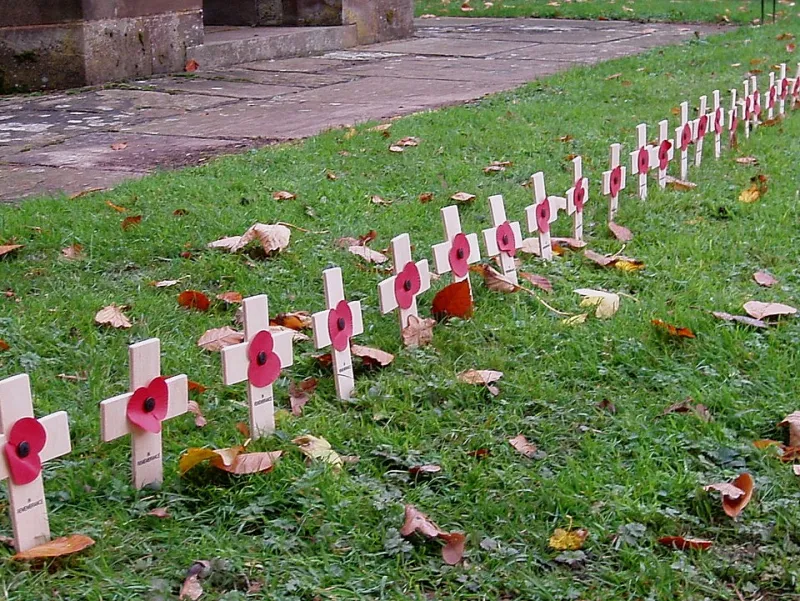
Photo: Amanda Slater, CC BY-SA 2.0, via Wikimedia Commons
Lest We Forget, and Yet Dare to Hope: Reimagining Remembrance in Chinnor's Churches
The eleventh hour of the eleventh day has held a particular gravity in British life for more than a century. In churches across the country, Remembrance Sunday has long served as one of the most attended services of the year—a moment when congregations swelled by those who rarely worship together gather to honour the fallen and to sit with the weight of collective loss. Yet in recent years, a quiet but significant conversation has been taking place within Chinnor's faith communities about the nature and purpose of that gathering, and about whether the traditional shape of the Remembrance service fully serves the congregation—or the occasion—as well as it might.
Between Patriotism and Pacifism
The tension at the heart of Remembrance Sunday in a church context is not new, but it has become more openly acknowledged. Christian theology, with its commitment to the sanctity of human life and its vision of reconciliation between peoples, does not sit without friction alongside the martial imagery and national pride that have historically characterised Armistice observances. For many within Chinnor's congregations, this friction is not a problem to be resolved but a reality to be held with honesty.
"We have people in our congregation who served in the armed forces and who feel very strongly about the traditions of Remembrance," reflects one local minister. "We also have people who are committed pacifists, people who have fled conflict themselves, and people who feel deeply ambivalent about any service that might appear to sanctify war. Our job is not to flatten those differences but to create a space where all of them can be held."
This pastoral challenge is increasingly shaping the design of Remembrance services across the Chinnor area. Rather than defaulting to a format that assumes a single emotional register—sombre pride, uncomplicated gratitude—local churches are developing liturgies that acknowledge complexity, invite honest reflection, and create room for a range of responses to the reality of human conflict.
Honouring the Local Fallen
One of the most powerful developments in recent Remembrance services across the Chilterns has been a renewed focus on the particular and the local. War memorials in and around Chinnor carry the names of individuals who were known—whose families still live in the area, whose stories can still be recovered and told. Several churches have invested significant time and research into recovering those stories, bringing individual names to life within the context of the service.
The effect of this personalisation is considerable. Where a list of names read aloud can feel, after many repetitions, like a ritual recitation, a brief account of a specific life—where a man grew up, what trade he followed, who he left behind—restores to the fallen their full humanity. Congregations that have experienced this approach consistently report that it transforms the emotional quality of the service.
"We read out the name of a young man from this village who died at the Somme," says one lay reader involved in organising a recent service. "We'd found a photograph and some letters. People were in tears—not just out of general sadness, but because they felt they actually knew him. That's what remembrance should do, I think. It should make the loss real."
Expanding the Circle of Remembrance
Perhaps the most significant shift in approach across Chinnor's churches in recent years has been the deliberate expansion of the circle of remembrance to include those who fall outside the traditional scope of Armistice observance. Refugees fleeing modern conflicts, civilian casualties of contemporary warfare, aid workers and peacekeepers who have lost their lives in service—all have begun to find a place within locally designed Remembrance liturgies.
This expansion is not without its complications. Some members of congregations feel strongly that Remembrance Sunday should retain its specific focus on those who served in the British armed forces, and that broadening its scope risks diluting its meaning. Others argue, with equal conviction, that a Christian theology of remembrance cannot be bounded by nationality—that the grief of a Syrian mother is no less worthy of acknowledgement than that of a Chilterns widow.
The churches navigating this debate have generally done so by creating services with sufficient breadth to hold both perspectives. A period of traditional military commemoration, complete with the Last Post and the two-minute silence, is followed by prayers that extend the circle of intercession to include all victims of conflict, wherever they may be. The two elements are not presented as contradictory but as complementary expressions of the same fundamental conviction: that human life is precious, and that its loss to violence is always to be mourned.
The Role of Creative Liturgy
Across the Chinnor area, churches are also experimenting with the creative and artistic dimensions of Remembrance services in ways that have proved deeply effective. One congregation has developed a practice of inviting members to bring objects connected to a family member affected by conflict—a medal, a letter, a photograph—and to place them at the foot of the altar as a physical act of remembrance. Another has incorporated spoken word poetry alongside the traditional bidding prayers, finding that contemporary voices can articulate aspects of grief and hope that the conventional liturgy does not always reach.
Music, too, is being approached with greater intentionality. Where some services have historically relied on a narrow repertoire of militaristic hymns, others are now incorporating pieces that speak more directly to the themes of peace, reconciliation, and hope—settings that allow the congregation to move, within the space of a single service, from lamentation to aspiration.
"We want people to leave feeling something other than just sadness," explains one worship leader. "Grief is right and necessary. But so is hope. The Christian story doesn't end at the cross, and our Remembrance services shouldn't end at the memorial."
A Conversation Worth Having
What is perhaps most encouraging about the evolution of Remembrance Sunday across Chinnor's faith communities is the quality of the conversation it is generating. The questions being asked—about the relationship between faith and national identity, about who deserves to be remembered and by whom, about how a church can honour sacrifice without endorsing violence—are not easy ones. But they are the right ones.
In asking them openly, in designing services that make space for honest disagreement alongside shared grief, Chinnor's churches are doing something that is both faithful to their theological convictions and genuinely responsive to the needs of their communities. They are demonstrating that remembrance, properly understood, is not a passive act of backward-looking sentiment but an active, demanding, and ultimately hopeful practice—one that insists on the value of every human life, and that refuses to let the dead be forgotten.