Keepers of the Hours: The Devoted Volunteers Winding Chinnor's Church Clocks
Keepers of the Hours: The Devoted Volunteers Winding Chinnor's Church Clocks
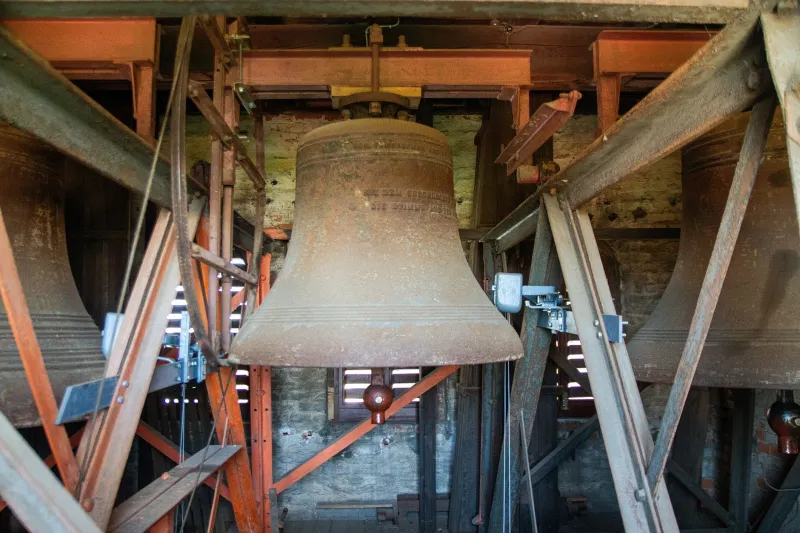
The staircase is narrow, the stone worn smooth by centuries of careful feet. At the top, past the ropes of the bell chamber and the accumulated dust of decades, sits a mechanism that most people in the village below have never seen — yet whose voice they hear every quarter-hour without thinking. The church clock. Ancient, intricate, and entirely dependent upon the attention of one or two people who have quietly taken it upon themselves to keep it running.
Across the Chilterns, in churches old and older still, these individuals exist. They are not paid. They are rarely thanked publicly. Many have been doing the job for so long that they can no longer quite remember how it began. And yet, without them, the towers would fall silent — and something in the character of these communities would be diminished in ways that are difficult to articulate but immediately felt.
Mechanisms of Devotion
Church clocks are, in mechanical terms, a remarkably varied family. Some are eighteenth-century movements of considerable sophistication, their brass wheels and steel arbors still performing with the precision their makers intended. Others are Victorian additions, installed during periods of church restoration and now themselves historical artefacts. A small number retain their original going-train weights, which must be wound by hand — sometimes daily, sometimes weekly — to keep the clock running.
For those who tend them, the mechanical complexity is part of the appeal. "Every clock has its own personality," explains one long-serving volunteer responsible for the timepiece in a Chilterns church that has stood for over six hundred years. "You learn its moods. You know when it's running a little fast, when the temperature has affected the pendulum, when something needs attention before it becomes a problem. It becomes second nature."
This intimate knowledge is rarely written down. It is passed between individuals — sometimes formally, more often through years of companionable apprenticeship — and represents a form of practical heritage that sits entirely outside the academic or institutional record. When a clock keeper retires or moves away, the knowledge they carry is not easily replaced.
The Silence That Follows
Those who have experienced the failure of a church clock often describe the resulting silence with a disproportionate sense of loss. The chime has been part of the acoustic landscape of the village for so long that its absence registers as something more than a mechanical inconvenience.
"When ours stopped for three months while we waited for a specialist to come," recalls a churchwarden from a village near Chinnor, "people kept mentioning it. Not just congregation members — people from the village who had no particular connection to the church. They'd say, 'Something feels off.' And they were right. It did."
This response points to something important about the social function of church clocks. They are not merely instruments of timekeeping — GPS and the smartphone have long since rendered them redundant for that purpose. They are, rather, markers of continuity. Their regular voice is a form of reassurance: that the church is present, that the community persists, that the ordinary rhythms of life are still being observed.
In this sense, the church clock keeper is not merely maintaining a mechanism. They are tending a relationship between a building and its community — one measured not in minutes but in generations.
Theological Time
It would be a mistake to consider the church clock as purely a civic amenity. Its placement on the tower — the highest point of a building explicitly oriented towards the transcendent — carries its own symbolic weight. Time, in Christian theology, is not an abstract backdrop to human activity. It is the medium within which God acts: the framework of creation, redemption, and hope.
The hours marked by a church clock are, in a sense, sacred hours. The tolling of the Angelus, the marking of canonical hours by monastic communities, the pealing of bells at Easter dawn — all speak to a tradition in which the measurement of time is itself an act of worship. To maintain the clock is, in this reading, to participate in a ministry far older than the mechanism itself.
Several of the clock keepers spoken to for this article are churchgoers; some are not. Yet even those without formal religious affiliation describe their work in terms that carry an unmistakable reverence. "I'm not sure I could explain why it matters so much," admits one volunteer, a retired engineer who has wound the same clock every week for twenty-two years. "But it does. It feels like a responsibility. Like something has been entrusted to me."
Restoration and Renewal
Across the Chilterns, a number of church clocks have in recent years undergone significant restoration — painstaking, expensive work that requires specialist horological expertise increasingly difficult to find. Charitable grants, local fundraising campaigns, and the quiet determination of small groups of volunteers have between them kept many of these movements alive.
The Chilterns Conservation Board and various ecclesiastical bodies have, at different times, offered guidance on the preservation of historic church furniture and fittings; clock movements, however, often fall into a gap between categories, their upkeep neither straightforwardly architectural nor purely liturgical. The result is that their survival depends, more often than not, on the initiative of individuals.
 Photo: Chilterns Conservation Board, via blooberrycreative.co.uk
In this, the church clock keeper embodies something characteristic of the wider voluntary tradition within Chinnor's faith communities: a willingness to take personal responsibility for something that belongs, in the deepest sense, to everyone.
Time Given Freely
There is an appealing paradox at the heart of this story. The people who give their time to maintain these clocks — climbing stairs in all weathers, learning the idiosyncrasies of ancient mechanisms, troubleshooting faults with limited resources — are, in a very literal sense, donating time in order to preserve time. Their commitment is measured not in hours of a single year but in the accumulated decades of faithful, unheralded service.
When the clock in the tower strikes the hour this Sunday morning, and the sound carries across the rooftops of Chinnor and the surrounding villages, it will do so because someone, somewhere, climbed those worn stone steps and did what needed to be done. It is, in its quiet way, a form of grace.
And it is worth knowing their names.