Glue, Glitter and Grace: The Beautiful Chaos of Messy Church Revolution
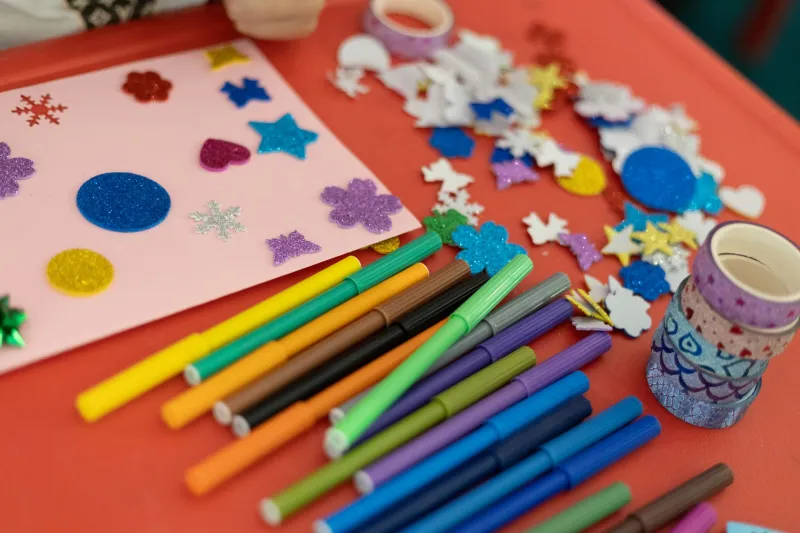
When Sunday Best Meets Sunday Mess
The scene in Chinnor Methodist Church's hall would horrify traditionalists: children with paint-stained fingers racing between craft tables, parents clutching coffee mugs whilst helping construct cardboard arks, and a general hubbub that would make a proper churchwarden reach for the smelling salts. Yet this controlled chaos represents one of the most significant grassroots movements reshaping British church life – and it's thriving across the Chilterns.
 Photo: Chinnor Methodist Church, via lustigespruche.com
Welcome to Messy Church, where faith gets its hands dirty and nobody minds if the angels in the nativity play have wonky halos and rather too much glitter.
The Accidental Revolution
Jenny Palmer never intended to start a revolution when she suggested craft activities for families at St Mary's three years ago. "We had this beautiful church building that felt empty on Sunday mornings," she recalls, wiping what appears to be poster paint from her sleeve. "Young families would visit for christenings or weddings, but they'd look terrified during regular services. We needed something different – something that felt less like a performance and more like a party."
 Photo: St Mary's, via cdn.bmwblog.com
That 'something different' has grown into a monthly gathering that regularly draws sixty people, many of whom had never considered themselves 'church people'. The format is beautifully simple: an hour of themed craft activities, followed by a short, interactive celebration and a shared meal. No hymn books, no formal liturgy, no expectations beyond showing up and joining in.
Beyond the Craft Tables
Dismissing Messy Church as merely organised childcare would miss its deeper significance. The movement addresses a fundamental challenge facing British churches: how to remain relevant to families whose lives no longer revolve around Sunday morning routines. For many participants, these gatherings represent their first meaningful encounter with Christian community.
"My daughter was struggling with anxiety about starting secondary school," explains Lisa Thompson, a regular at Christ Church's monthly Messy Church. "During our 'New Beginnings' session, she made a prayer box for her worries whilst chatting with other children facing the same transition. By the time we sat down for jacket potatoes, she'd found her courage again. You can't quantify that kind of ministry."
 Photo: Christ Church, via kalendare.su
The genius lies in the informality. Parents who might feel self-conscious about their theological knowledge find themselves discussing faith whilst helping children construct biblical scenes from egg boxes and pipe cleaners. Conversations flow naturally from craft instructions to life's bigger questions, mediated by the shared task at hand.
The Volunteers' Perspective
Running Messy Church requires a particular kind of stamina and an acceptance that things will go wonderfully wrong. Margaret Foster, who coordinates the programme at St Bartholomew's, laughs as she describes the learning curve: "Our first attempt at making Moses' burning bush involved real candles and paper leaves. The fire alarm went off, the children screamed, and I thought we'd traumatised everyone for life. Now we use battery-operated tea lights and everyone remembers it as the day the burning bush nearly burned down the church."
The volunteer commitment is substantial – planning themed activities, sourcing materials, preparing simple meals, and clearing up afterwards. Yet most speak of unexpected rewards. "I've learned more theology helping six-year-olds understand the parable of the lost sheep than I did in years of traditional Bible study," admits David Williams, a retired teacher who helps with craft preparation. "Children ask the questions adults are too polite to voice."
Theological Tensions
Not everyone embraces the Messy Church model. Some worry about theological content being diluted, about worship becoming entertainment, about the absence of traditional elements like hymns and formal prayers. These concerns deserve serious consideration, particularly in communities where church traditions run deep.
Rev. Michael Harrison acknowledges the tension: "I've had long-standing members express concern that we're 'dumbing down' the faith. But when I see children who've never heard the story of the Good Samaritan acting it out with playmobil figures, or parents who've never prayed aloud offering simple thanks before our shared meal, I wonder whether we've actually been making faith too complicated."
The Stepping Stone Question
Perhaps the most pressing question surrounding Messy Church concerns its relationship with traditional worship. Is it a stepping stone towards conventional church membership, or a destination in itself? The evidence suggests both outcomes occur, often unpredictably.
Some families do progress from Messy Church to Sunday services, particularly when their children show interest in joining youth groups or confirmation classes. Others find their spiritual needs fully met by monthly gatherings that combine creativity, community, and celebration. A few drift away once their children outgrow craft activities, but many speak of seeds planted that continue growing in unexpected directions.
The Pandemic Pivot
COVID-19 forced Messy Church communities to reimagine their approach, with mixed results. Some attempted online craft sessions, posting activity packs through letterboxes and gathering virtually for short celebrations. Others suspended activities entirely, waiting for the return of communal mess-making.
The restart has been revealing. Many communities report higher attendance than before the pandemic, suggesting that families used the enforced break to recognise what they'd been missing. "People realised that Messy Church wasn't just about keeping children occupied," observes Jenny Palmer. "It was about belonging to something bigger than their immediate family."
Looking Ahead
As Messy Church approaches its second decade, questions about sustainability and development arise. Some communities are exploring age-specific variants – Messy Teens, Messy Adults, even Messy Seniors. Others are integrating elements into traditional services, recognising that the boundary between formal and informal worship continues shifting.
What remains constant is the movement's fundamental insight: faith communities thrive when they create space for authentic encounter, whether that happens in ancient liturgy or around craft tables covered in glue and glitter. In the Chilterns' churches, that space increasingly looks beautifully, magnificently messy.
The revolution continues, one paper plate angel at a time.