Created to Care: Why Chinnor's Green Churches Argue That Stewardship Is Theology
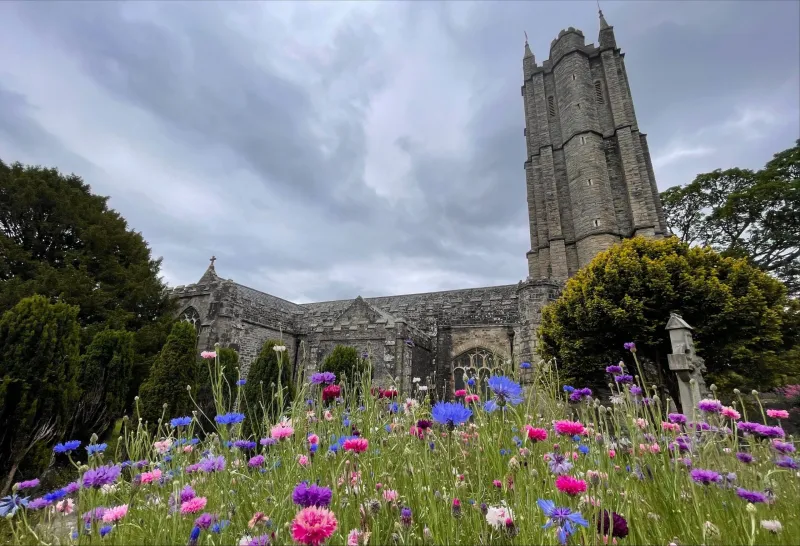
Photo: eco churchyard wildflowers solar panels English church, via exeter.anglican.org
Created to Care: Why Chinnor's Green Churches Argue That Stewardship Is Theology
The churchyard at first glance appears untended. The grass is long, threaded with ox-eye daisies and red clover. A section near the northern boundary has been left entirely to its own devices, and the result is a tangle of nettles, bramble, and wildflower that would once have prompted a letter of complaint from a neighbouring parishioner. Today, it bears a small wooden sign explaining that this is a designated wildlife corridor — home to hedgehogs, slow worms, and a colony of bees that arrived, uninvited and entirely welcome, two summers ago.
This is not neglect. It is intention. And across Chinnor's faith communities, it is becoming increasingly common.
A Framework for Faithful Action
A Rocha UK's Eco Church scheme, launched in 2016, offers congregations a structured pathway towards environmental responsibility, assessed across five areas: worship and teaching, management of church buildings, management of church land, community and global engagement, and lifestyle. Bronze, silver, and gold awards mark stages of progress, with the gold award representing a comprehensive and embedded commitment to creation care across every aspect of church life.
 Photo: A Rocha UK, via arocha.org.uk
The scheme has grown steadily since its inception, with over a thousand churches across England and Wales now registered. In the Chilterns, the uptake has been notable — several local congregations have already achieved bronze or silver status, and at least one is working towards gold. The motivations vary: some churches were prompted by younger congregation members, others by clergy with a longstanding interest in environmental theology, others simply by the practical reality of ageing buildings with escalating energy bills.
What unites them, however, is a refusal to treat environmental action as an optional extra — a concession to contemporary sensibility rather than a demand of the faith itself.
The Theological Case
This is, it should be said plainly, an opinion worth arguing. There are those within the Church who remain sceptical of what they see as the politicisation of the Gospel — a suspicion that environmental activism is a secular agenda dressed in liturgical clothing. It is a view that deserves to be engaged rather than dismissed.
Yet the theological case for creation care is not a modern invention. It is woven through the Hebrew scriptures — in the creation narratives of Genesis, in the Psalms' exuberant celebration of the natural order, in the Levitical provisions for land sabbath and the release of the jubilee year. The New Testament adds to this a Christological dimension: the Incarnation itself affirms the goodness of material creation, and Paul's letter to the Romans speaks of the whole creation groaning in anticipation of redemption.
"This is not a political add-on," says one Chinnor-area vicar who has been leading her congregation through the Eco Church process for the past three years. "When we talk about caring for creation, we are talking about faithfulness to the God who made it and called it good. It is as central to the Gospel as anything else we do."
This position is increasingly articulated in official Church of England documents, including the 2020 General Synod motion committing the Church to net-zero carbon emissions by 2030 — an ambition that has filtered down to individual congregations with varying degrees of urgency and resource.
What Change Looks Like in Practice
For Chinnor's congregations, the practical implications of eco-church commitment span a wide spectrum. At the simpler end: switching to LED lighting, sourcing Fairtrade refreshments for church events, and introducing recycling facilities into church halls. These are modest measures, but they are not trivial — they signal a culture shift, an acknowledgement that the choices made within a church building carry moral weight.
More ambitious interventions include the installation of solar panels — a project that several Chilterns churches have undertaken, navigating the sometimes complex planning requirements that apply to listed buildings. Where successful, the results have been both practically and symbolically significant. "There is something rather wonderful," observes one churchwarden who oversaw a solar installation completed last year, "about an ancient building generating its own power from the sun. It feels entirely right."
The management of churchyard land has emerged as a particularly fruitful area of engagement. The traditional closely-mown churchyard — neat, green, and ecologically barren — is giving way, in a number of local churches, to a more nuanced approach. Designated areas of long grass, native wildflower planting, the removal of unnecessary pesticide use, and the installation of bat and bird boxes have transformed several Chilterns churchyards into genuine wildlife habitats without compromising their dignity or accessibility.
The Voice of the Next Generation
In church after church, the impetus for environmental action has come, at least in part, from younger congregation members — teenagers and young adults who have grown up with climate change as a defining reality of their world and who find in the Eco Church framework a way of connecting their faith to their deepest concerns.
"I used to feel like these were two separate parts of my life," says one young woman in her early twenties who has been involved in her church's eco group since its formation. "My faith was something I had in church, and my concern about the environment was something I had everywhere else. The Eco Church process helped me understand that they belong together. That actually, my faith gives me the strongest possible reason to care."
This integration is precisely what the most thoughtful advocates of eco-church work are seeking to foster. Not a church that has bolted an environmental programme onto its existing activities, but a community of faith whose understanding of the Gospel is capacious enough to encompass the whole of creation — and whose practical life reflects that understanding.
A Witness to the World
There is, finally, a missiological dimension to this work that should not be overlooked. A church whose building is solar-powered, whose churchyard hums with wildlife, whose events are catered with ethical sourcing and minimal waste, is making a statement to its surrounding community that goes beyond words. It is demonstrating, in the most concrete terms possible, that faith is not a private matter sealed within stone walls but a way of inhabiting the world — and of caring for it.
In Chinnor, where the Chilterns landscape is both a daily reality and a cherished inheritance, that witness carries particular force. The hills and valleys, the ancient hedgerows and chalk streams, are not merely a backdrop to community life. They are, for many residents, a primary encounter with beauty and transcendence — a place where, as one local put it with quiet conviction, "you can almost hear what the Psalms are talking about."
To care for that landscape — to tend it, to restore it, to refuse its degradation — is, for Chinnor's green churches, nothing less than an act of worship.
The bees in the churchyard, it seems, are doing their part. The question is whether the rest of us will follow.