Finding Your Voice: The Unexpected Joy of Adult Choirs in the Chilterns
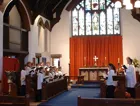
Photo: Basilcat1, CC BY-SA 4.0, via Wikimedia Commons
There is a moment, familiar to many who have joined a church choir as an adult, when self-consciousness gives way to something altogether different. It happens, perhaps, during a rehearsal when the harmonies suddenly align and the sound produced by the group exceeds anything any individual could achieve alone. In that moment, something shifts. What began as a tentative commitment becomes, for many, a life-changing one.
Across the Chinnor area, this experience is being replicated with increasing frequency. Church choirs and congregational singing groups are reporting a notable and sustained growth in adult membership—not among those who grew up reading music or trained in choral technique, but among ordinary people who simply felt drawn to sing.
A Welcome Beyond Audition
The traditional image of the church choir—robed, disciplined, musically literate—has long been a barrier to participation for adults who lack formal training. Yet the singing groups flourishing in Chilterns churches today are, in many cases, deliberately moving away from that model. The emphasis, in congregation after congregation, is on welcome rather than qualification.
"We don't audition," says the director of one vocal group that has more than doubled in size over the past three years. "If you can hold a tune and you want to sing, you're in. We'll do the rest together."
This inclusive ethos has proved enormously effective. Several groups report that a significant proportion of their current membership joined with no previous choral experience whatsoever, having been encouraged by a friend, attracted by a poster, or simply feeling—often after years of sitting in the pews listening to others sing—that they, too, had something to contribute.
The absence of an audition requirement does not, it should be noted, imply an absence of musical ambition. Many of these groups perform to a high standard at major services, festivals, and community events. The difference lies in how that standard is reached: through patient, encouraging rehearsal practice rather than selective recruitment.
The Wellbeing Dimension
The growth in adult choral participation in Chinnor's churches coincides with a broader national conversation about the mental and physical health benefits of communal singing. Research conducted over the past decade has highlighted the positive effects of group singing on mood, anxiety levels, and social connectedness—findings that resonate strongly with the lived experience of choir members across the Chilterns.
"I joined the choir eighteen months after my husband died," says one member of a church singing group in the area. "I was lonely in a way I couldn't quite describe. The choir gave me somewhere to be, something to focus on, and people who actually noticed whether I turned up or not. That mattered more than I can say."
This account is far from unusual. Across the congregations contacted for this article, similar stories emerge: people who joined during periods of illness, isolation, or significant life change, and who found in the weekly rhythm of rehearsal and performance a structure and a community that proved genuinely sustaining.
The physical act of singing itself plays a role in this. Controlled breathing, vocal projection, and the concentrated attention required for part-singing all have measurable physiological effects. Several choir members report improved sleep, reduced anxiety, and a general sense of vitality that they attribute, at least in part, to their regular singing practice.
Deepening Congregational Identity
Beyond individual wellbeing, the growth of adult choirs in Chinnor's churches carries significance for the life of the congregation as a whole. Music has always been central to Christian worship—the Psalms themselves are a collection of sung poetry—and the quality and character of congregational singing shapes the experience of worship for everyone present.
Where a choir is genuinely embedded in the life of a congregation rather than operating as a separate entity, its effect can be transformative. Members who sing together in rehearsal on a Thursday evening bring a different quality of engagement to Sunday worship. They know the music more deeply, listen more carefully, and contribute more confidently. Their presence can lift the singing of an entire congregation.
"A strong choir doesn't perform to the congregation," observes one church music director. "It leads from within. There's a difference, and people feel it."
This distinction matters particularly in smaller churches, where the choir may represent a substantial proportion of the worshipping community. In such contexts, the choir's health and vitality is closely linked to the health and vitality of the congregation itself.
Songs Across Generations
One of the most striking features of the current growth in adult choral participation is its intergenerational character. Whilst some groups are predominantly composed of older adults, others have successfully attracted members across a wide age range, creating communities of song that cross the generational boundaries which so often divide church congregations.
The repertoire these groups choose reflects their diversity. Traditional anthems and hymns sit alongside contemporary worship songs, folk-influenced pieces, and arrangements drawn from global Christian traditions. This breadth is not merely aesthetic; it represents a genuine attempt to honour the varied backgrounds and tastes of a mixed membership.
"We sing things that would have been completely unfamiliar to me ten years ago," admits one choir member in her sixties. "And I've come to love them. That's been a surprise. I think singing them together makes you open to them in a way that just listening wouldn't."
An Open Invitation
For those who have long harboured a private wish to sing but have never felt confident enough to step forward, the message from Chinnor's choral communities is clear and consistent: the door is open, the welcome is genuine, and the voice you bring—however uncertain—is the voice that is needed.
The choirs and singing groups active across the Chilterns are not looking for perfection. They are looking for people who are willing to show up, to listen, to learn, and to add their voice to the great communal song that has been at the heart of Christian worship for two thousand years.
In that participation, many have found something they did not know they were searching for: a place to belong, a reason to return, and a joy that, week by week, continues to grow.