In a Chinnor Vestry on a Tuesday: The Faithful Few Who Pray the Week into Being
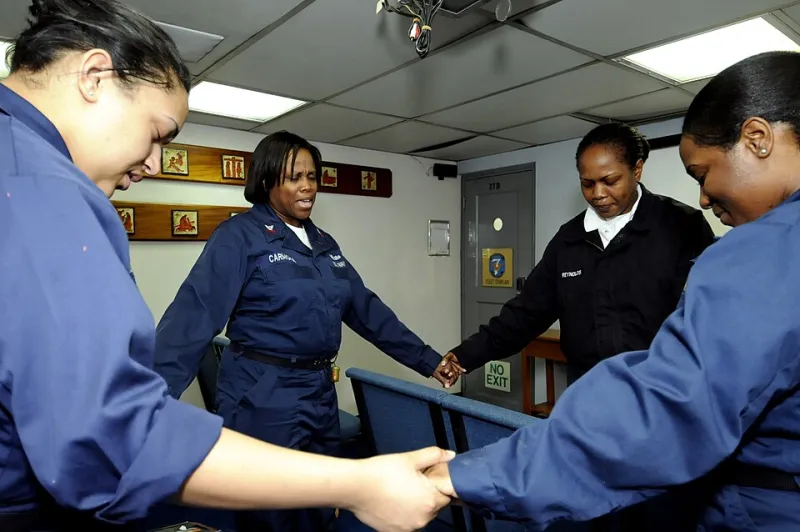
Photo: U.S. Navy photo by Mass Communication Specialist 2nd Class Cynthia Griggs, Public domain, via Wikimedia Commons
The vestry at one of Chinnor's Anglican churches is not a grand space. A row of coat hooks along one wall holds the surplus and stoles of a Sunday that has already passed. A kettle, a jar of instant coffee, and a small stack of mismatched mugs occupy a folding table in the corner. Six chairs have been arranged in a rough circle, close enough that the people sitting in them might easily reach across and take one another's hand — which, on occasion, they do.
It is twenty past nine on a Tuesday morning. Outside, the village is moving through its ordinary rhythms: school runs completing, commuters departing, the post office opening its doors. In here, a group of five women and one man have settled into their chairs and allowed the world outside to recede. They have come to pray.
A Gathering Without Fanfare
The Tuesday group at this particular church has been meeting, in various configurations, for more than a decade. It does not advertise itself widely. It does not appear prominently in the church newsletter. New members tend to find it through word of mouth — a quiet recommendation from someone who noticed them lingering after a service, or a gentle suggestion from the vicar to someone navigating a difficult season.
"I came the first time because a friend told me it helped her," says Anne, a retired district nurse in her late sixties who has attended for four years. "I wasn't sure what to expect. I thought it might be a bit formal, a bit churchy. But it wasn't like that at all. It was just people being honest with God about the things that were weighing on them."
This informality is characteristic of the weekday prayer groups operating across Chinnor and the surrounding area. They are distinct from the midweek communion services offered by several local churches, and distinct again from the house groups and Bible study circles that form part of the established programme of most congregations. They exist in a quieter register — less structured, less visible, and in some ways more demanding.
The Practice of Intercession
The format of the Tuesday group is loose but consistent. There is an opening prayer, usually brief. Then a period of shared intercession, in which members bring to the group the names and situations they have been carrying through the preceding week: a neighbour recently diagnosed with a serious illness; a family in the community known to be struggling financially; a situation of conflict within the church itself; a national or global concern that has pressed itself upon the conscience. Each offering is received without comment or advice. The group simply prays.
"We don't try to solve things," explains Margaret, who has been attending since the group's earliest days. "That's not what we're here to do. We're here to bring things before God and trust that something happens when we do. Whether we understand the mechanism or not."
This last phrase — whether we understand the mechanism or not — captures something essential about the theology underpinning such gatherings. The members of Chinnor's weekday prayer groups are not, by and large, people given to triumphalist claims about answered prayer. They are, rather, people who have arrived at a steady conviction that prayer matters — that it changes things, including themselves — without feeling obliged to construct a precise account of how.
Who Comes, and Why
Across the various weekday prayer gatherings in the Chinnor area — there are at least four operating with some regularity, across different denominations and in different settings — a broadly similar demographic presents itself. The majority of regular attenders are women. The majority are over fifty. Most are retired or working part-time. This pattern is not surprising: the practical demands of a weekday morning gathering exclude many younger people and those in full-time employment.
Yet the groups resist easy sociological categorisation. Tom, the one man in the Tuesday vestry group, is fifty-three and works irregular hours as a self-employed tradesman. He rearranges his schedule to attend. "I started coming after a very hard period in my life," he says simply. "I needed somewhere I could be honest about how things were. Sunday mornings are wonderful, but there isn't always space to be that honest. Here, there is."
The honesty Tom describes is a recurring theme. Several members speak of the weekday prayer group as a space in which the performance aspects of Sunday worship — the dressing up, the social interaction, the presentation of a composed self — fall away. In the vestry on a Tuesday, there is no congregation to impress, no liturgical role to fulfil. There is only the circle of chairs, the mugs of coffee, and the accumulated weight of the things being carried.
Does It Change Anything?
The question of whether communal prayer produces tangible effects in the world is one that the members of these groups engage with thoughtfully and without defensiveness. None claims a direct line of causation between a Tuesday morning intercession and a subsequent improvement in a neighbour's health or a resolution to a community conflict. The faith at work here is more subtle and, arguably, more mature than that.
"I think prayer changes me," says Anne. "It changes the way I see the person I've been praying for. It changes the way I act towards them. And if enough people are changed in that way, perhaps that is how things improve in the world." She considers this for a moment. "Though I also believe that God hears and responds. I just don't think I'm in a position to audit the process."
The Reverend Jonathan Clarke, who occasionally joins the Tuesday group when his schedule permits, offers a pastoral perspective. "These groups are the spiritual infrastructure of a congregation," he says. "They are not glamorous. They don't produce events or outputs. But they hold the community in prayer in a way that nothing else quite replicates. I have seen the difference in churches that have them and churches that don't, and it is real."
 Photo: Reverend Jonathan Clarke, via images.squarespace-cdn.com
The Quiet Ministry
As the Tuesday session draws to a close — fifty minutes after it began — the group pauses in a final silence before the closing prayer. The kettle is switched on. Conversation resumes, gentle and warm. Outside, the village continues its day, entirely unaware of what has taken place in this small room.
That anonymity is, for most members, not a source of frustration but of quiet satisfaction. They are not here for recognition. They are here because they believe — with the steady, undemonstrative conviction of people who have tested the belief across years — that what happens in this circle matters. That the names spoken aloud in this vestry are heard somewhere beyond the walls. That Tuesday mornings, in their modest and unhurried way, are doing something essential in the life of this community.
"People sometimes ask me what I do on Tuesday mornings," Margaret says, wrapping her hands around her mug. "I say I go to a prayer group. They usually nod politely and change the subject." She smiles. "That's all right. It doesn't need to be understood from the outside. It only needs to be done."