Where the Sermon Has No Walls: Chinnor's Congregations Take Worship onto the Chiltern Hills
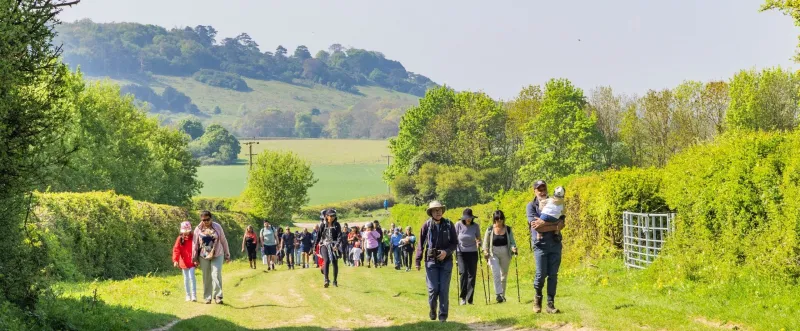
Photo: group of people walking on Chiltern Hills footpath countryside, via www.chilterns.org.uk
The congregation gathers at the foot of Chinnor Hill just after ten on a Sunday morning, but nobody is wearing their best clothes. There are walking boots, thermos flasks and a great deal of good humour. There is no organ, no lectern and — perhaps most strikingly — no front row.
This is walking church, and it is quietly changing how people in the Chinnor area think about worship.
A Service That Moves
The concept is disarmingly simple. Rather than sitting in a building for an hour, the congregation walks. A route is chosen — often a stretch of the Ridgeway or a loop across the fields towards Whiteleaf — and the elements of a conventional service are woven into the journey. A psalm is read at the summit. A reflection is offered halfway up the slope, when legs are tired and minds are unguarded. Prayers are said in motion.
'It changes what people are willing to say,' explains one of the organising team, a lay reader from one of Chinnor's parish churches. 'Someone who would never speak in a pew will open up on a footpath, side by side, not face to face. There is something about walking that unlocks honesty.'
The format borrows from the ancient tradition of pilgrimage, but strips away the formality. There is no expectation that participants know the liturgy, can name the books of the Bible, or even believe very much at all yet.
The Theology of the Journey
It would be easy to dismiss walking church as a novelty — Christianity with a rambling club attached. Those who organise it push back firmly against that reading.
Scripture, they point out, is saturated with journeys. The Exodus, the exile, the road to Emmaus, the ministries that unfolded entirely on foot across Galilee. Jesus taught while walking; parables were delivered to people moving through landscape. For much of Christian history, the pilgrimage was not a metaphor but a discipline.
'When you climb Chinnor Hill on a Sunday morning, you are doing it in your body, not just in your head,' says one regular participant. 'Worship in a building can become very cerebral. Out here, the effort of the climb becomes part of the prayer. You arrive at the top having already given something.'
Weather, mud and stiles are embraced rather than lamented. A rained-off walk recently became a huddle under a beech tree with shared umbrellas — which several attendees described as among the most memorable services of their year.
An Unlikely Doorway for Newcomers
Perhaps the most significant impact has been on those who would never cross a church threshold. The informality of a walk lowers the barriers that formal worship can raise. There is no unfamiliar hymn book to navigate, no moment where a newcomer visibly does not know what to do.
Several current regulars first joined simply because a friend asked them along for a walk. The spiritual content was, for some, initially incidental. 'I came for the company and the views,' one admits. 'I stayed for rather more than that.'
The walks also attract those on the fringes of congregational life — parents whose children have grown, former churchgoers alienated by a bad experience, and dog walkers curious enough to stop and listen.
Practicalities and an Open Invitation
Routes are chosen to be manageable — typically three to four miles, with shorter options available and a meeting point accessible for those arriving by car. Walks conclude with refreshments, often a flask of coffee produced from a rucksack with something approaching liturgical ceremony.
The schedule is publicised through the parish notices and local noticeboards, and newcomers need nothing beyond sensible footwear.
As one organiser put it: 'The church building is precious. But God has a rather larger property portfolio, and some of it is on our doorstep. It seems a shame not to use it.'
For a community surrounded by some of the most storied walking country in England, the Ridgeway is proving to be more than an ancient trackway. On Sunday mornings, it is a nave without a roof.