A Table Wide Enough for Everyone: Chinnor's Interfaith Gatherings and the Art of Honest Dialogue
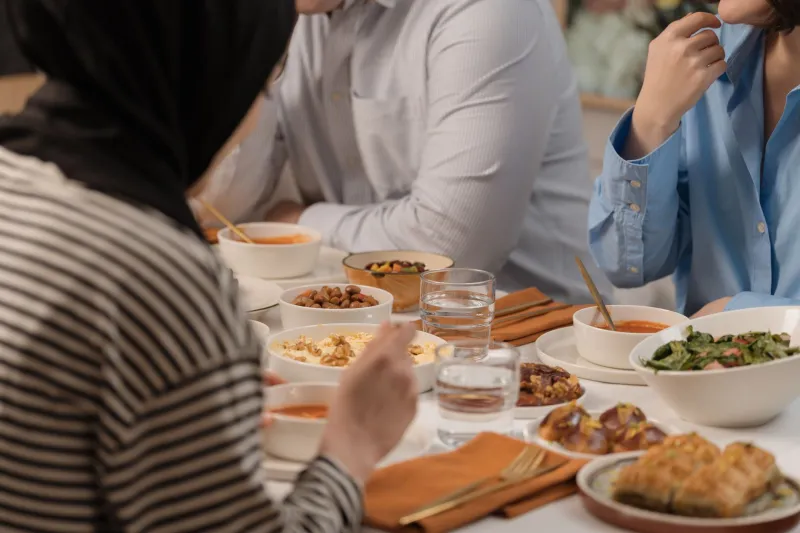
Breakfast Before Theology
The meeting begins, as most good things in England do, with tea. There are also pastries, a dish of dates, a plate of bagels, and what one regular attendee cheerfully describes as "a fairly heroic quantity of jam." The room is a church hall in the Chinnor area, the morning is grey and autumnal, and the people gathered around the tables represent a range of faiths and convictions that would have seemed remarkable in this part of Oxfordshire even twenty years ago.
Christians of several denominations sit alongside a small number of Jewish families who have settled in the area. A Muslim couple who moved to the Chilterns from Birmingham several years ago are regulars. A Sikh man who commutes to Oxford and attends when his schedule allows brings homemade paratha, which disappears quickly. Two self-described secular humanists, one of whom is a retired philosophy lecturer, come every month without fail. "I'm not here for the theology," she says pleasantly. "I'm here because these are the most interesting conversations I have all month."
This is the Chinnor area's interfaith breakfast gathering — informal in structure, serious in intent, and rather harder to categorise than its cheerful surface might suggest.
How It Began
The gathering did not emerge from an official initiative or a denominational programme. It grew, as many of the most durable community endeavours do, from a single act of hospitality. A local minister, troubled by what she perceived as a growing mutual unfamiliarity between the faith communities of the Chinnor area, invited a small number of people from different backgrounds to her home for breakfast. The conversation lasted three hours. Everyone left wanting to continue it.
Within a few months, the gathering had outgrown a domestic setting and moved to a church hall. A WhatsApp group emerged. A loose mailing list developed. There is still no formal membership, no committee, and no agenda beyond a short opening reflection — offered in turn by someone from a different tradition each month — followed by conversation over food.
"We were very deliberate about not making it too organised," explains one of the founding participants. "The moment you have a constitution and a chairperson, people start performing for the institution rather than speaking to one another. We wanted it to feel like a meal between friends who happen to disagree about quite important things."
The Theology of Disagreement
It would be dishonest to present interfaith dialogue as uniformly comfortable. The breakfast group has had its difficult mornings. Conversations about the Israeli-Palestinian conflict have required careful navigation. Differing views on gender, sexuality, and religious authority have surfaced, sometimes unexpectedly. There have been moments when the gap between worldviews has felt very wide indeed.
What has kept the group together, participants say, is a shared commitment to what might be called honest hospitality — the willingness to remain at the table not despite disagreement but through it. This requires a particular kind of intellectual and emotional courage. It is considerably easier to maintain warm relations with people of other faiths by avoiding the subjects on which you genuinely differ.
"Superficial interfaith dialogue is actually quite easy," observes the retired philosophy lecturer. "You find what you have in common — kindness, community, care for the vulnerable — and you celebrate that. Which is fine, as far as it goes. But it doesn't go very far. The interesting work starts when you sit with someone whose understanding of God, or of human nature, or of what happens after death, is genuinely different from yours, and you try to understand it rather than smooth it over."
The Christian participants in the group have found this challenge particularly instructive. The tradition of dialogue within Christianity itself — between denominations, between theological schools, between liberals and conservatives — has provided some preparation for the broader encounter. But sitting with someone whose foundational commitments differ from your own at the most basic level is a different kind of exercise.
Practical Collaboration Beyond the Table
The breakfast gathering has, over time, generated something beyond conversation. Several practical collaborations have emerged from the relationships formed over those monthly tables. A joint collection for a local food bank, organised across faith communities, produced a significantly larger response than any single congregation could have managed alone. A community garden project on land adjacent to one of the Chinnor-area churches has drawn volunteers from several different faith backgrounds.
During the period of national bereavement following the death of Queen Elizabeth II in 2022, the group organised a joint vigil that drew participants from across the full range of communities represented at the breakfast table. It was, by several accounts, one of the most moving acts of communal prayer that the Chinnor area had witnessed in recent memory — not despite its diversity, but because of it.
"There is something that happens when people of genuinely different beliefs stand together in grief or in hope," reflects one participant. "It doesn't dissolve the differences. But it reveals something underneath the differences that is also real."
What 'Community' Means Now
For Chinnor's established churches, the interfaith breakfast represents both an opportunity and a challenge. The opportunity is clear: genuine engagement with the full diversity of the local population, relationships built on honesty rather than assumption, and a witness to the wider community that faith is capable of generosity rather than defensiveness.
The challenge is equally real. Deepened engagement with other faiths raises theological questions that cannot always be neatly resolved. It requires a confidence in one's own tradition that is neither brittle nor aggressive — a security that allows genuine curiosity about others without anxiety about one's own convictions.
The people who gather for breakfast in that church hall each month have not resolved these tensions. They do not pretend to have done so. What they have done is decide that the tensions are worth living with — that the table is worth keeping wide, the kettle worth keeping on, and the conversation worth continuing, however unfinished it remains.
In a rural English village, in the early decades of a complicated century, that may be exactly the kind of faith that the moment requires.